Fresenius Medical Care (FMS)·Q4 2025 Earnings Summary
Fresenius Medical Care Delivers Exceptional Q4 as Margin Expansion Hits 430bps, Stock Falls on Flat 2026 Outlook
February 24, 2026 · by Fintool AI Agent
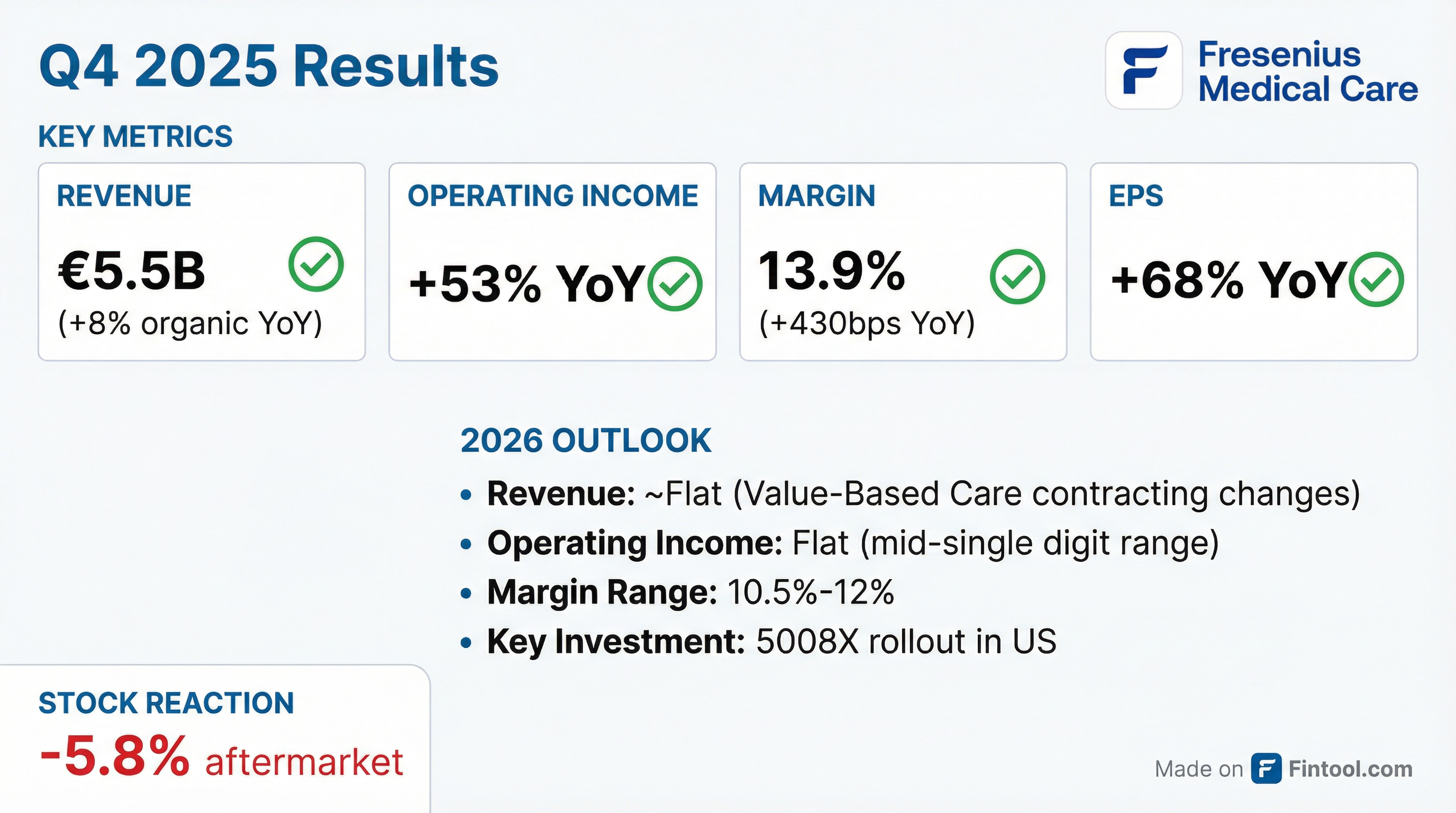
Fresenius Medical Care (FMS) capped off a milestone 2025 with an exceptional fourth quarter, delivering 8% organic revenue growth, 53% operating income growth, and margin expansion of 430 basis points to 13.9% . Despite achieving the upper end of 2025 guidance across all metrics, the stock fell approximately 5.8% in aftermarket trading as investors focused on the company's flat 2026 outlook amid regulatory headwinds.
Did Fresenius Medical Care Beat Earnings?
FMS delivered a decisive beat on operating metrics:
Values from Q4 2025 earnings call
For full-year 2025, operating income grew 27%, reaching the top end of the company's ambitious outlook . The group margin hit 11.3%, driven by contributions from all three operating segments .
Key drivers of Q4 outperformance:
- TDAPA benefits: Phosphate binders contributed ~€220M for FY 2025, with ~€70M from antimicrobial catheter solutions in Q4 alone
- FME25+ savings: €238M in additional sustainable savings achieved in 2025, ahead of the €220M target, bringing total program savings to €804M
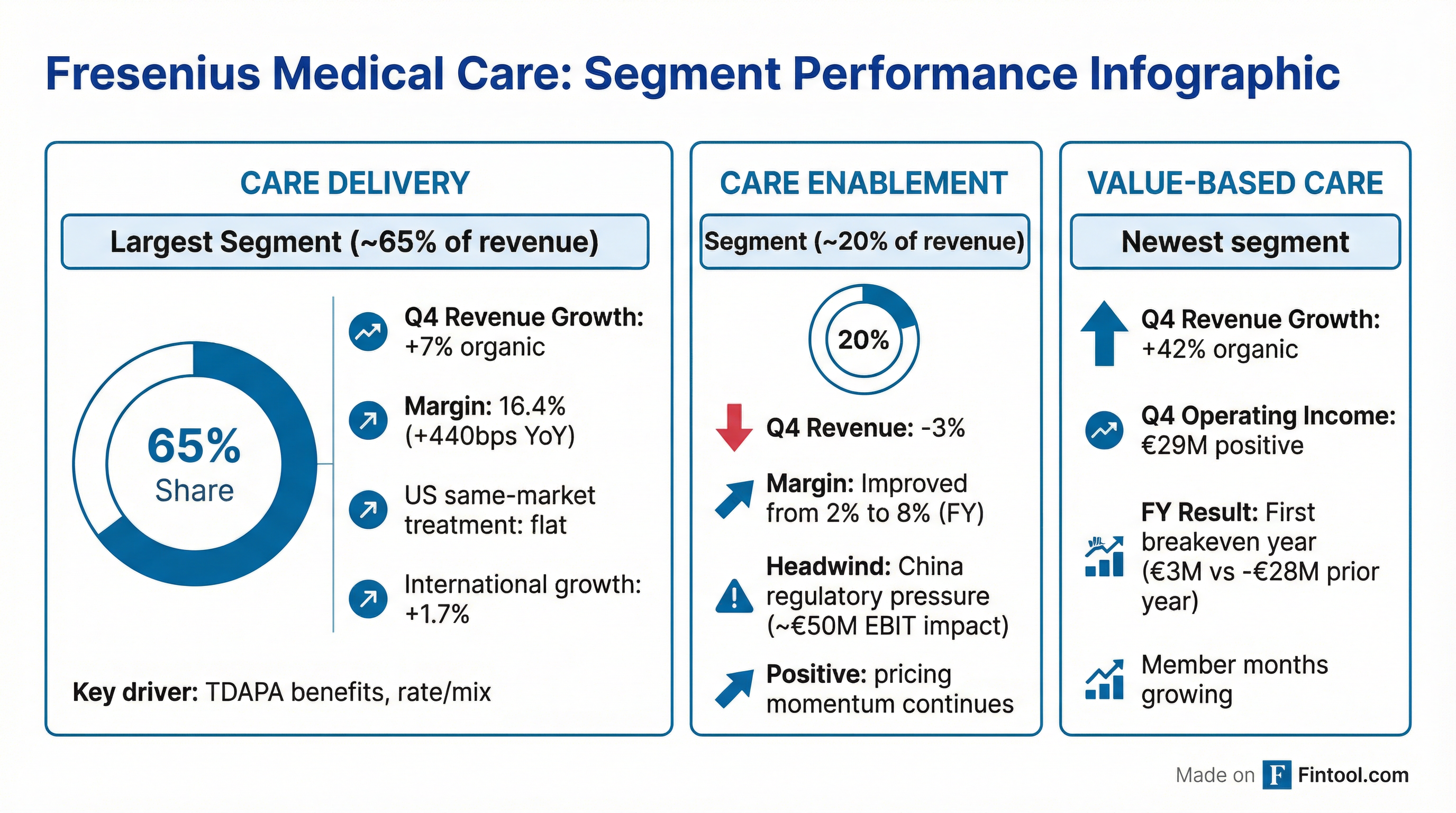
- Care Delivery: U.S. rate and payer mix remained favorable; margin reached 16.4% in Q4 (+440bps YoY)
- Value-Based Care: First breakeven year with €3M positive operating income vs. €28M loss in 2024
 Ask Fintool AI Agent
What Did Management Guide for 2026?
Despite the strong Q4 finish, FMS guided for a transition year in 2026:
2026 headwinds and tailwinds breakdown (per management):
CEO Helen Giza emphasized that the flat outlook reflects deliberate investment: "2026 will be a transition year, which does not change our aspiration to achieve industry-leading growth and margins" .
How Did the Stock React?
FMS closed at $24.59 on February 23, 2026, but fell to $23.17 in aftermarket trading — a decline of approximately 5.8%. The selloff came despite the operational beat, reflecting market concern over:
- Flat 2026 guidance vs. expectations for continued growth
- TDAPA phase-out: €150-200M regulatory headwind as phosphate binder benefits expire
- ACA subsidy expiration: ~€50M headwind from extended tax subsidies ending
- Investment year: 5008X rollout costs and IT platform investments totaling €100-150M
The stock has traded between $20.95 and $30.46 over the past year, with the current price near the middle of that range.
What Changed From Last Quarter?
Several notable developments emerged in Q4:
Positive changes:
- Value-Based Care profitability: Turned positive in Q4 (€29M operating income) after years of losses
- Accelerated share buyback: Completed €586M in 2025, initiated additional €414M in January 2026
- Net leverage improvement: Reduced to 2.5x from 3.4x at end of 2022
Emerging headwinds:
- U.S. treatment volumes: Same-market treatment growth remained flat amid elevated mistreatments from weather and flu
- China regulatory pressure: ~€50M EBIT impact in 2025 from value-based procurement changes; expected to continue in 2026
- Clinic closures announced: ~100 U.S. clinics to close in 2026 as part of footprint optimization
Ask Fintool AI AgentSegment Performance Deep Dive
Care Delivery (Core Dialysis Business)
Care Delivery delivered 7% organic revenue growth in Q4 and achieved a 16.4% margin — up 440 basis points year-over-year .
For FY 2025, Care Delivery margin reached 13.1%, hitting the middle of management's target band .
Care Enablement (Products & Services)
Care Enablement faced headwinds in Q4, with revenue declining 3% due to China regulatory pressures .
Management noted China represents 7-10% of Care Enablement revenue and is exploring local strategies to mitigate the impact .
Value-Based Care (Medicare Risk)
The standout performer was Value-Based Care, which achieved its first breakeven year:
Q4 benefited from favorable savings rates, partially offset by unfavorable CKCC program effects .
The 5008X Rollout: A Multi-Year Investment
The 5008X CAREsystem rollout represents the largest clinic infrastructure transition in company history — CEO Giza called it "the largest product launch in our company's history" . Key details:
- 2026 target: Replace ~20% of U.S. installed base
- Training scope: 7,200+ nurses and technicians, 36,000 patient transitions across 28 states
- Manufacturing base: Primarily produced at German facilities in Schweinfurt and Sindelfingen
- Clinical benefits: CONVINCE study showed 23% lower mortality risk vs. standard hemodialysis
- Early feedback: Patients report increased energy, improved sleep, shorter recovery times; nurses highlight automated workflows
- Timeline: Positive effects expected to ramp throughout 2026-2027, with greater benefit in 2027+
Management emphasized the rollout is "well on track" and expects to provide a detailed progress update at half-year results .
Capital Allocation & Shareholder Returns
FMS demonstrated strong cash generation and disciplined capital allocation:
Long-Term Outlook: 2028 and 2030 Targets
Management reaffirmed ambitious longer-term targets:
CEO Helen Giza noted: "If we exclude the noise resulting from the interim TDAPA tail and headwinds throughout this period, our implied earnings growth trajectory through 2028 would be in the low teens on a CAGR basis" .
Q&A Highlights
On volume recovery (Q: Hugo, BNP): Management expects a slow start to 2026 with volumes potentially in negative territory initially, targeting return to 2%+ same-market treatment growth by 2029 as HDF benefits materialize .
On TDAPA phase-out (Q: Graham, UBS): The phosphate binder TDAPA period ends in 2026, with some benefit (~€100M) staying in the business. The antimicrobial catheter solution is year-over-year neutral (H2 2025 benefit vs. H1 2026 benefit) .
On corporate costs (Q: James, Jefferies): EUR 200-220M guided for 2026, up due to IT platform investments (SAP S/4HANA transition) and FX impacts from global function cross-charges .
Ask Fintool AI AgentManagement Team Updates
Early 2026 saw key leadership additions to strengthen execution on the FME Reignite strategy :
- Joe Turk — CEO, Care Enablement
- Charles Hugh-Jones — Global Chief Medical Officer
- Tommy O'Connor — CEO, InterWell Health (Value-Based Care)
Tariff Exposure Update
During the press conference, management addressed current tariff uncertainty :
- 2025 impact: "Very immaterial" due to product classification protocols and large U.S. manufacturing footprint
- 2026 outlook: Assumes tariffs in place as of late February; some impact expected from purchased goods sourced overseas
- Mitigation: Management monitoring developments and will pursue refund opportunities if available
CEO Helen Giza noted: "We feel good about our assumptions for 2026, and of course, if there's an opportunity to seek a refund, we will put our best foot forward there" .
Key Risks to Monitor
- TDAPA regulatory cliff: €150-200M headwind in 2026 as temporary benefits phase out
- U.S. treatment volume pressure: Mistreatments and mortality remain elevated; 2%+ growth not expected until 2029
- China regulatory uncertainty: Continued headwinds from value-based procurement policies
- 5008X execution risk: Largest infrastructure transition requires training 7,200+ staff
- ACA policy changes: Potential further headwinds if subsidies are modified
- Tariff uncertainty: Fluid policy environment; overseas-sourced goods could face additional duties
The Bottom Line
Fresenius Medical Care delivered an exceptional Q4 2025 that capped a transformational three-year journey. The company hit the upper end of its 2025 outlook, achieved meaningful margin expansion across all segments, and reached Value-Based Care breakeven for the first time. However, the stock reaction reflects the market's focus on what's ahead: a transition year in 2026 with flat growth as TDAPA benefits fade and investments in the 5008X rollout take priority.
For long-term investors, the key question is whether the 5008X rollout can deliver on its promise of improved patient outcomes and operational efficiencies — benefits that management expects to increasingly support results in 2027 and beyond.